


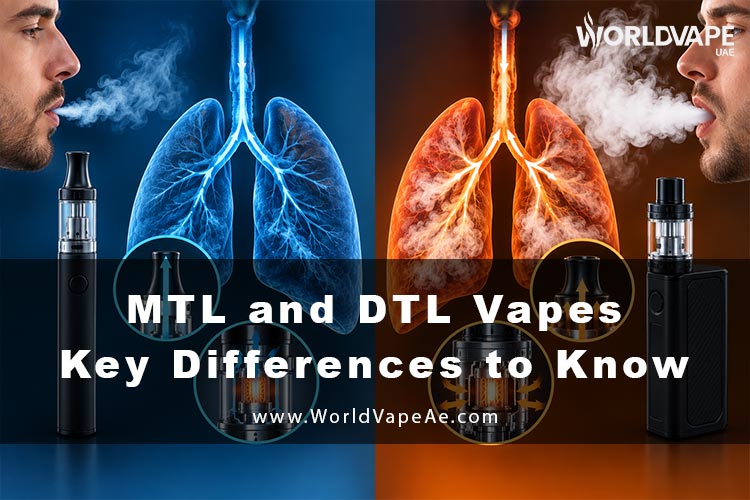
If you’re comparing different vape devices, you’ve probably come across two terms: MTL (Mouth-to-Lung) and DTL (Direct-to-Lung).
These terms describe how you inhale vapor, but the difference goes beyond the way you draw from a vape. MTL and DTL setups can feel very different because they typically use different airflow settings, coil resistances, power levels, and nicotine strengths.
So, which one should you choose?
The answer depends on the kind of inhale you prefer, how much vapor you want, the nicotine strength you’re using, and the type of device you have.
In this guide, we’ll break down MTL vs DTL vaping, explain how each style works, compare their key differences, and help you understand which setup may suit your preferences.
MTL vs DTL: What’s the Difference?
The simplest way to understand the difference is to look at how the vapor is inhaled.
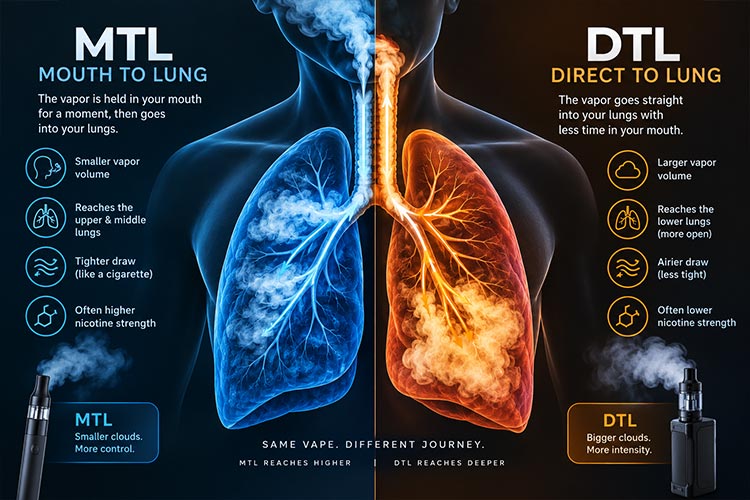
MTL (Mouth-to-Lung) means drawing vapor into your mouth first and then inhaling it into your lungs. The sensation is relatively similar to smoking a traditional cigarette.
DTL (Direct-to-Lung) means inhaling the vapor directly into your lungs in one continuous draw. It usually produces a more open inhale and significantly larger vapor clouds.
In simple terms:
| Feature | MTL | DTL |
|---|---|---|
| Inhale style | Mouth, then lungs | Directly into lungs |
| Airflow | Tight/restricted | Open/airy |
| Vapor production | Low to moderate | High |
| Typical coil resistance | Higher resistance | Lower resistance |
| Power | Lower wattage | Higher wattage |
| Nicotine | Often higher | Usually lower |
| E-liquid | Often suited to nicotine salts | Often suited to lower-strength e-liquid |
| Device type | Pods, disposables, MTL tanks | Sub-ohm kits, powerful pod mods |
| Battery consumption | Lower | Higher |
| E-liquid consumption | Lower | Higher |
Neither style is automatically “better.” They’re simply designed around different vaping experiences.
What Is MTL Vaping?
MTL stands for Mouth-to-Lung.
With an MTL inhale, you first draw vapor into your mouth and then take it into your lungs. This creates a tighter, more controlled draw that many people find familiar.
Think of the difference between sipping through a narrow straw and breathing through an open tube. MTL is closer to the first experience.
What Does MTL Vaping Feel Like?
MTL vaping generally provides:
- A tighter draw
- Smaller vapor clouds
- A more controlled inhale
- Lower power consumption
- Less e-liquid consumption
- A sensation that can resemble smoking
- Compatibility with relatively higher nicotine strengths
Because the airflow is restricted, the vapor can feel more concentrated and the overall experience is usually more discreet.
This is one reason MTL devices are common among people who prefer compact vape products or want a vaping experience that doesn’t produce large clouds.
What Devices Are Best for MTL?
MTL isn’t limited to one particular type of vape. However, some devices are particularly well suited to this style.
Pod Vapes
Compact pod systems are commonly designed around MTL or restricted MTL vaping. They generally use lower power and smaller coils, making them convenient for everyday use.
Disposable Vapes
Many disposable devices are designed primarily for MTL or a relatively restricted inhale. They’re simple because the battery, coil and e-liquid are already integrated into the device.
For someone browsing a disposable vape dubai selection, checking the airflow and draw style can be more useful than simply choosing a device based on puff count.
MTL Tanks
Refillable tanks can also be configured specifically for MTL. These setups typically use higher-resistance coils and relatively low power.
What Is DTL Vaping?
DTL stands for Direct-to-Lung.
Instead of holding the vapor in your mouth first, you inhale it directly into your lungs.
The airflow is much more open, allowing a significantly larger volume of air and vapor to pass through the device.
DTL vaping is therefore very different from the tighter sensation of MTL.
What Does DTL Vaping Feel Like?
DTL generally provides:
- A much more open draw
- Larger vapor clouds
- Higher airflow
- Higher power output
- Greater e-liquid consumption
- Faster battery consumption
- Lower nicotine strengths in most setups
Because more vapor is produced with each puff, DTL setups are generally paired with lower nicotine concentrations than typical MTL setups.
What Devices Are Best for DTL?
DTL vaping generally requires equipment capable of producing more vapor and handling higher power.
Sub-Ohm Tanks
Sub-ohm tanks are among the most common choices for DTL vaping.
They use low-resistance coils and are designed to operate at higher wattages. The larger airflow openings allow more air to reach the coil, helping produce dense vapor.
High-Power Pod Mods
Some modern pod mods can support both restricted lung and direct-to-lung vaping. Their flexibility makes them useful for people who don’t want to be limited to a single draw style.
Rebuildable Devices
Advanced users may also use rebuildable tanks or drippers for DTL vaping. These setups offer extensive control over coils, airflow and power but require considerably more knowledge and maintenance.
They aren’t usually the most practical starting point for someone who is simply trying to understand the difference between MTL and DTL.
MTL vs DTL: Airflow Differences
Airflow is one of the easiest ways to distinguish MTL from DTL.
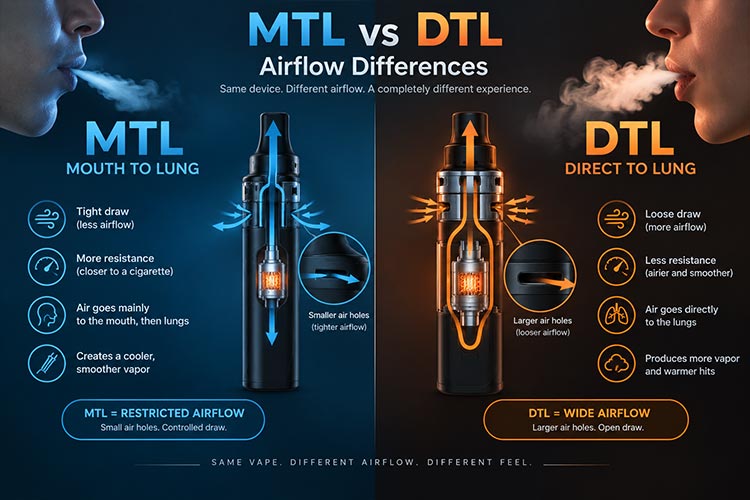
MTL Airflow
MTL devices generally use a tighter airflow.
Less air enters the coil, resulting in a more restricted draw. Many devices allow you to adjust the airflow so you can make the inhale tighter or slightly more open.
A narrow mouthpiece is also common.
DTL Airflow
DTL devices use much more open airflow.
The increased airflow helps cool the vapor while allowing more vapor to be inhaled in a single draw. DTL devices therefore tend to have larger airflow openings and wider drip tips or mouthpieces.
If a vape feels extremely airy when you inhale, it is likely designed for DTL or restricted DTL use.
MTL vs DTL Coil Resistance
Coil resistance is another important difference.
MTL setups commonly use higher-resistance coils, often above 1.0 ohm, although there are exceptions.
DTL setups commonly use sub-ohm coils, meaning coils below 1.0 ohm.
The important point isn’t simply the number printed on the coil. Resistance works together with wattage, airflow and coil design to determine how much vapor the device produces.
As a general rule:
Higher resistance + lower power → more MTL-oriented experience
Lower resistance + higher power → more DTL-oriented experience
However, modern vape technology has blurred these boundaries, so coil resistance alone shouldn’t be used to determine the inhale style.
MTL vs DTL Nicotine Strength
Nicotine strength is one of the most important considerations when choosing between MTL and DTL.
MTL devices usually produce less vapor per puff, so they are commonly paired with higher nicotine concentrations.
Salt nicotine, in particular, is frequently used in MTL pod systems because it allows higher nicotine concentrations in a compact device.
DTL devices produce substantially more vapor per puff. As a result, using a high-nicotine e-liquid in a powerful DTL setup can provide an unnecessarily strong nicotine intake and may feel unpleasant.
For that reason, DTL vaping is generally associated with lower nicotine strengths.
The right nicotine strength depends on the specific product, local regulations, personal circumstances and manufacturer guidance, so always check the product labeling rather than assuming a particular strength is appropriate.
Which Produces More Vapor: MTL or DTL?
If vapor production is your priority, DTL produces considerably more vapor than MTL in typical setups.
There are several reasons:
- DTL devices generally use more open airflow.
- They often operate at higher power.
- Their coils can vaporize more e-liquid per puff.
- The direct-lung inhale allows a larger volume of vapor to be inhaled.
MTL, on the other hand, focuses on a tighter and more controlled draw.
So if you want large clouds, DTL is generally the better match. If you prefer smaller, more discreet vapor production, MTL is usually more suitable.
Which Has Better Flavor: MTL or DTL?
This is more subjective.
MTL can provide a concentrated flavor experience because the vapor is produced in smaller quantities and the draw is more restricted.
DTL can also produce intense flavor, particularly with modern sub-ohm coils and high-quality e-liquids. Because the coil can vaporize a larger amount of e-liquid, the overall flavor output can be powerful.
Rather than saying one style always has better flavor, it’s more accurate to say that they deliver different flavor experiences.
MTL tends to feel more concentrated and controlled, while DTL can feel fuller and more expansive.
MTL vs DTL Battery and E-Liquid Consumption
Another practical difference is efficiency.
MTL devices typically operate at lower power, meaning they generally use less battery power and e-liquid.
This can make compact MTL devices convenient for people who want something lightweight and easy to carry.
DTL setups consume considerably more power because they need to heat the coil at higher wattages. They also vaporize more e-liquid with each puff.
That means you’ll generally need to:
- Charge the battery more frequently
- Refill the tank more often
- Carry more e-liquid if you’re away from home
If convenience and portability are your priorities, MTL has a clear practical advantage.
Can One Vape Do Both MTL and DTL?
Yes, some devices can support both styles.
Modern pod mods and adjustable vape kits often include adjustable airflow and support multiple coil options.
For example, a device may offer a tighter airflow and higher-resistance coil for MTL, while another compatible coil and more open airflow can provide a restricted-lung or DTL experience.
However, a device advertised as “MTL and DTL compatible” doesn’t necessarily provide an equally good experience for both.
The coil, airflow range, power output and mouthpiece all matter.
If versatility is important to you, look for a device with:
- Adjustable airflow
- Multiple compatible coils
- A broad wattage range
- MTL and DTL-compatible pod or tank options
MTL vs DTL: Which One Should You Choose?
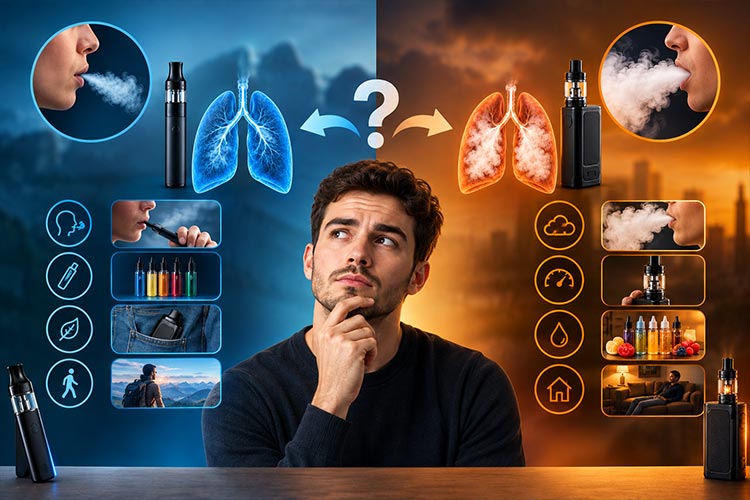
The easiest way to decide is to start with the experience you’re looking for.
Choose MTL if you prefer:
- A tighter inhale
- Smaller vapor clouds
- A more discreet vaping experience
- Lower e-liquid consumption
- Lower battery consumption
- Compact pod-style devices
- Higher nicotine strengths
Choose DTL if you prefer:
- A very open inhale
- Large vapor clouds
- Higher vapor production
- More powerful devices
- Lower nicotine strengths
- Sub-ohm vaping
- A more intense vapor experience
If you’re still unsure, don’t focus only on the device. Consider the airflow, coil, wattage and e-liquid strength together.
MTL vs DTL: What About RDL?
There is also a middle ground known as RDL (Restricted Direct-to-Lung).
RDL isn’t as tight as a traditional MTL draw, but it isn’t as open as a full DTL inhale either.
You inhale directly into the lungs, but the airflow remains somewhat restricted.
This makes RDL useful for people who find MTL too tight but DTL too airy.
Some modern pod devices are specifically designed to move between MTL and RDL, giving users more flexibility without requiring a large sub-ohm setup.
MTL vs DTL: Quick Decision Guide
Still not sure which style fits you?
Use this simple guide:
Want a cigarette-like, tighter draw? → MTL
Want large clouds and an airy draw? → DTL
Want something between the two? → RDL
Prefer a compact pod or disposable? → MTL is often the better starting point
Want a powerful sub-ohm setup? → DTL
Prefer higher nicotine concentrations? → MTL-oriented devices are generally more suitable
Prefer lower nicotine concentrations with high vapor production? → DTL
If you’re comparing products from a vape shop dubai, check the device’s recommended coil range, airflow design and e-liquid compatibility instead of choosing based on appearance alone.
Final Thoughts
The difference between MTL and DTL vaping ultimately comes down to how you inhale and how the device delivers vapor.
MTL provides a tighter, more controlled draw and is commonly associated with compact pod devices, disposable vapes and higher nicotine e-liquids.
DTL provides a much more open inhale and is designed around higher vapor production, more airflow and lower nicotine strengths.
Neither style is universally better.
The best choice depends on the experience you want from your device.
If you’re shopping for vaping products in the UAE, World Vape UAE provides a range of vape products for different preferences and device types. Before choosing a product, pay attention to its intended inhale style, coil compatibility, airflow and recommended e-liquid strength.
Most importantly, understand the device before using it. Following the manufacturer’s recommendations for coils, wattage and e-liquid helps you get the intended experience from your vape.
If you’re comparing options through world vape uae, knowing whether a device is designed for MTL, RDL or DTL can make the buying decision much easier.
Frequently Asked Questions
What is the main difference between MTL and DTL vaping?
MTL (Mouth-to-Lung) vaping involves drawing vapor into your mouth before inhaling it into your lungs, creating a tighter, more restricted sensation. DTL (Direct-to-Lung) vaping involves inhaling vapor directly into the lungs and typically produces a more open draw and larger clouds.
Is MTL or DTL better for beginners?
MTL is generally easier for beginners to get used to because its tighter draw is closer to the way a traditional cigarette is inhaled. Compact pod systems and many disposable vapes are designed around an MTL-style experience.
Does MTL use more nicotine than DTL?
MTL devices are commonly paired with higher nicotine strengths because they produce less vapor per puff. DTL devices produce considerably more vapor, so they are generally used with lower nicotine strengths. Always follow the manufacturer’s recommended nicotine range for your device.
Can you use nicotine salts with MTL vapes?
Yes. Nicotine salts are commonly used in MTL-oriented pod devices because these devices typically operate at lower power and produce smaller amounts of vapor. Always check that the e-liquid strength is compatible with your specific device.
Which produces bigger clouds, MTL or DTL?
DTL vaping generally produces much larger clouds than MTL because it uses more open airflow, lower-resistance coils and higher power levels. MTL is designed for a more controlled and discreet vapor output.
Is DTL vaping stronger than MTL?
DTL can feel more intense because it delivers a larger volume of vapor with each inhale. However, the overall sensation also depends on the coil, wattage, airflow and nicotine strength of the e-liquid.
Can one vape be used for both MTL and DTL?
Some adjustable vape devices can support both MTL and DTL or RDL vaping. Devices with adjustable airflow and multiple compatible coil options generally provide more flexibility, although not every device performs equally well for both styles.
What coil is best for MTL vaping?
MTL vaping typically uses higher-resistance coils and lower power levels. The exact coil resistance depends on the device, so it’s important to use the coil type and wattage range recommended by the manufacturer.
What coil is best for DTL vaping?
DTL devices commonly use sub-ohm coils with lower resistance and higher power requirements. These coils are designed to produce more vapor and work with the more open airflow associated with direct-to-lung vaping.


